I was reading Piet Schreuder's (et al) 1994 book, The Beatles' London: A Guide To 467 Beatles Sites In And Around London and I found a listing for Paul and George visiting English song-and-playwright Lionel Bart's home sometime in August, 1966. As I said in my March post, I'm trying to track down when Paul disappeared from public view.
In the listiing, it said that soccer player Bobby Moore was also at Bart's house that night. So I went looking for a book about Moore and found he wrote one, in 1970, called England! England!.
He wrote an entire chapter on England's first World Cup win in 1966. He was a member of the winning English team and they won in England, giving a special meaning to the title and the players amongst the English.
They won the match and trophy on Saturday, July 30, 1966.
The team was treated to a special banquet in their honor the evening of July 30th. Moore said:
"No wives or girl-friends were invited to the banquet and as finally we took our various presents up to our rooms in the Royal Garden when the feting was over, we all then split up into our parties with our wives and others to disappear into the night here, there and everywhere to continue our various junketings."
And, later in the chapter, Moore said:
"This last event [the World Cup] in a way, of course, helped to widen my horizon, change my social life and make it busier. I found myself being feted and asked out here, there and everywhere, making personal appearances."
I found a 1994 book written by David Roper called Bart! The Unauthorized Life & Times Ins And Outs Ups And Downs Of Lionel Bart that states that the 1966 World Cup-winning squad had their post-match party at Bart's house.
So, since Bobby Moore was introduced to Lionel Bart's night scene on July 31, 1966 and since Moore mentioned our Paul's Revolver album song, "Here, There and Everywhere" twice in describing his widening social life, I think it's a good guess that he met our Paul some night at Lionel Bart's house in August, 1966. But, again, no photos.
Thursday, May 1, 2014

Is This Our Paul at the Ivor Novello Award Ceremony, July 12, 1966?
I found an extremely short video on Youtube that is supposed to be our Paul accepting two Ivor Novello awards for his and John's 1965 songs, "Yesterday" and "We Can Work It Out." You can see the whole video at: www.youtube.com/watch?v=INvqw4qKjF8 .
As I said in my last post, I've been searching unsuccessfully for photographs of Paul past early July, 1966. The award ceremony was held July 12th.
Again, I have not found any photographs of Paul from the awards ceremony. ???
Also, see my next post because it's very possible that Paul was around London laying low, so to speak, as late as August, 1966.

As I said in my last post, I've been searching unsuccessfully for photographs of Paul past early July, 1966. The award ceremony was held July 12th.
Again, I have not found any photographs of Paul from the awards ceremony. ???
Also, see my next post because it's very possible that Paul was around London laying low, so to speak, as late as August, 1966.
Saturday, March 29, 2014
No Credible Photos of Paul Past July,1966
I have been searching unsuccessfully for ANY credible photo of our Paul past the photo of him that was taken in early July, 1966 when he was in India. (See photo in my post of October 10, 2010.)
Paul was supposed to have attended a performance of experimental music at the Royal College of Art in London on September 15, 1966. There was a group of musicians and the composer Cornelius Cardew and about a dozen people in the audience but I have not found one photograph from the concert.
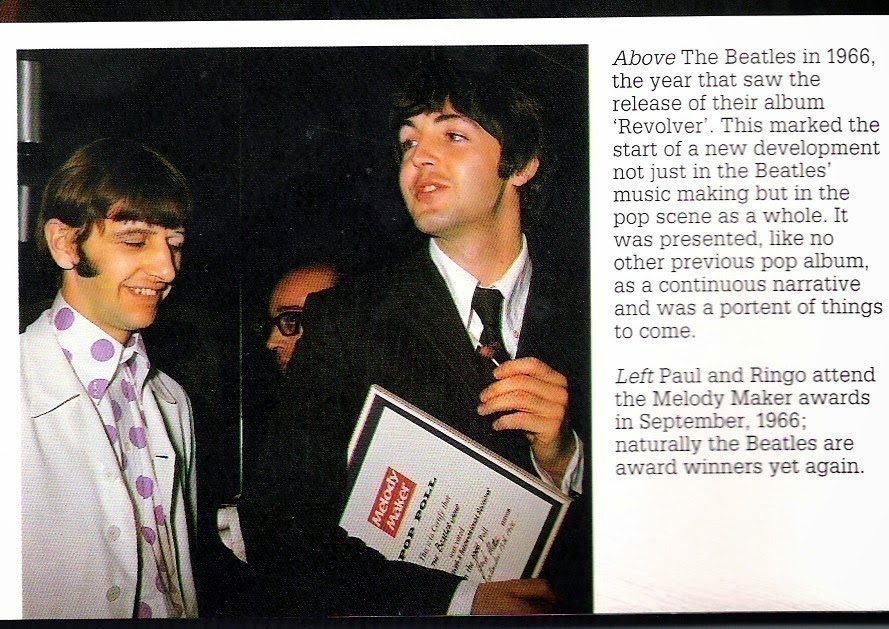 Paul (and Ringo) were supposed to have accepted an award from the English pop music magazine Melody Maker on September 13, 1966. A very hazy short film from the awards ceremony and several photographs have surfaced. I always thought the photos looked doctored and then found another photo from a English music photographer, David Redfern. (See right.) THIS Paul looks like one of the 1966 American tour look-alikes.
Since I do not believe our Paul was in the 1966 American tour group I'm seriously thinking that all the chatter from the new Beatles and the other musicians was about things happening to our Paul beginning some time after early JULY, 1966.
Paul was supposed to have attended a performance of experimental music at the Royal College of Art in London on September 15, 1966. There was a group of musicians and the composer Cornelius Cardew and about a dozen people in the audience but I have not found one photograph from the concert.
Paul (and Ringo) were supposed to have accepted an award from the English pop music magazine Melody Maker on September 13, 1966. A very hazy short film from the awards ceremony and several photographs have surfaced. I always thought the photos looked doctored and then found another photo from a English music photographer, David Redfern. (See right.) THIS Paul looks like one of the 1966 American tour look-alikes.Since I do not believe our Paul was in the 1966 American tour group I'm seriously thinking that all the chatter from the new Beatles and the other musicians was about things happening to our Paul beginning some time after early JULY, 1966.
Thursday, March 13, 2014
Several Clues That The Real John Survived, But Was Crippled
I mentioned in my post about the "personnel changes" in The Beatles that I had found some strong hints that the real John lived, but ended up (somehow) in a wheelchair. Here are the clues.
1.) Bob Dylan recorded a song for his Blonde on Blonde album called "4th. Time Around." The song was recorded in February, 1966 and released in May, 1966. It was supposed to be Dylan's satirical jab at John Lennon and his supposedly borrowing Dylan's songwriting rhymes and rhythms. The relevant lyrics are:
And I tried to make sense
Out of that picture of you in your wheelchair.
- - - -
I never asked for your crutch [meant literally]
Now don't ask for mine. [meant figuratively]
2.) The real John Lennon's son, Julian recorded a song called "I Don't Wanna Know" and made a video to go with it. Late in the video, it shows one of The Beatles in a wheelchair.
 I think that was supposed to be his father.
3.) I described in other posts the clues in the 1978 mockumentary about The Beatles, All You Need Is Cash. Well, another clue for us all came in the "What Became of The Rutles" segment when the commentator described the John character: "Nasty turned his back on the world, and sat for many years with his thoughts and his memories." And here is how Nasty is shown:

1.) Bob Dylan recorded a song for his Blonde on Blonde album called "4th. Time Around." The song was recorded in February, 1966 and released in May, 1966. It was supposed to be Dylan's satirical jab at John Lennon and his supposedly borrowing Dylan's songwriting rhymes and rhythms. The relevant lyrics are:
And I tried to make sense
Out of that picture of you in your wheelchair.
- - - -
I never asked for your crutch [meant literally]
Now don't ask for mine. [meant figuratively]
2.) The real John Lennon's son, Julian recorded a song called "I Don't Wanna Know" and made a video to go with it. Late in the video, it shows one of The Beatles in a wheelchair.
3.) I described in other posts the clues in the 1978 mockumentary about The Beatles, All You Need Is Cash. Well, another clue for us all came in the "What Became of The Rutles" segment when the commentator described the John character: "Nasty turned his back on the world, and sat for many years with his thoughts and his memories." And here is how Nasty is shown:
Friday, February 28, 2014
Did Our Paul Ever Make It To France in November, 1966?
I looked into our Paul's purchase of an Aston Martin DB6 in 1966. According to the Aston Martin website: www.astonmartins.com/db4_5_6-s/db6.htm , Paul took delivery of the car in March, 1966. There is also a mention in Maureen Cleave's article about our Paul published in The London Evening Standard, March 25, 1966, that Paul was driving his new DB6.
I've searched Google images, though, and I have not found a credible image of our Paul in or near that car. However, I have found several images of Faul in and near the car, including Mal Evans' home video shots of Faul in Spain (probably) or Kenya.


 Which begs the question: Was the future Beatle Faul given Paul's car or was the DB6 purchased for Faul? The car made it over to France in November, 1966, but it looks like Paul was not with it.
I've searched Google images, though, and I have not found a credible image of our Paul in or near that car. However, I have found several images of Faul in and near the car, including Mal Evans' home video shots of Faul in Spain (probably) or Kenya.
Friday, January 31, 2014
Other Voices, Part 13: The Moody Blues' Message To Eddie
The Moody Blues recorded a song called "Leave This Man Alone" in July, 1967 and it was released as the b-side of a single in September, 1967. (Here the entire song at: https://www.youtube.com/watch?v=Vueuu4wMXrU ). The lyrics suggest a man confused and in anguish. Part of the lyrics are:
Someone said I loved you, but I can't think where (I can't think where).
You know so much about me
So don't stand and stare, stand and stare.
Leave me, leave me, leave me, leave my mind alone.
Leave me, leave me, leave me, leave this man alone.
But the most interesting part of the song is heard backward. Twice at the beginning, twice at the end, and once in the middle of the song, you hear the backmasked message:
Keep your head up . . . Eddie.
The name Ed and Eddie are mentioned twice by the final configuration of The Beatles.
First: In the movie, Imagine: John Lennon, The final John is having a conversation with George:
John: You see much of The Beatles these days, the other Beatles?
George: I saw Beatle . . . Beatle Ed.
John: Beatle Ed? How is he?
George: Oh, he was all right, but he was just going off on a tour.
John: Beatle Ed's not doing too well these days, is he? Beatle Ed.
George: Oh, he's number 5 in Sweden.
John: Oh, in Sweden, I see . . . . (And John gives a big wink to the camera.)
Second: The final Paul recorded an impromptu song called "There you are, Eddie" during the Let It Be sessions in 1969. (Here the song at: https://www.youtube.com/watch?v=ijwI7wgXbxE ).
Obviously, there had been a Beatle by the name of Ed in the group. It wasn't a current Beatle at the time and it wasn't the original, real John or Paul, so the real name of either our Paul or our John was Ed and it appears that the Moody Blues had been trying to send a message of encouragement to him in 1967.
Someone said I loved you, but I can't think where (I can't think where).
You know so much about me
So don't stand and stare, stand and stare.
Leave me, leave me, leave me, leave my mind alone.
Leave me, leave me, leave me, leave this man alone.
But the most interesting part of the song is heard backward. Twice at the beginning, twice at the end, and once in the middle of the song, you hear the backmasked message:
Keep your head up . . . Eddie.
The name Ed and Eddie are mentioned twice by the final configuration of The Beatles.
First: In the movie, Imagine: John Lennon, The final John is having a conversation with George:
John: You see much of The Beatles these days, the other Beatles?
George: I saw Beatle . . . Beatle Ed.
John: Beatle Ed? How is he?
George: Oh, he was all right, but he was just going off on a tour.
John: Beatle Ed's not doing too well these days, is he? Beatle Ed.
George: Oh, he's number 5 in Sweden.
John: Oh, in Sweden, I see . . . . (And John gives a big wink to the camera.)
Second: The final Paul recorded an impromptu song called "There you are, Eddie" during the Let It Be sessions in 1969. (Here the song at: https://www.youtube.com/watch?v=ijwI7wgXbxE ).
Obviously, there had been a Beatle by the name of Ed in the group. It wasn't a current Beatle at the time and it wasn't the original, real John or Paul, so the real name of either our Paul or our John was Ed and it appears that the Moody Blues had been trying to send a message of encouragement to him in 1967.
Saturday, January 18, 2014
Here's A Summary of My Theory on The Beatles' "Personnel Changes"
-----Happy New Year and Let This Be The Year We Find The Truth-----
It's a given that sometime in mid-to-late 1966 our Paul (the Paul McCartney American fans knew) was replaced by the third and final Paul. The whole mystery dogging our memory of The Beatles is what happened to the first two Pauls (and Johns.) Some people focus on the why of their replacement, but for our Paul I believe the official why would be a lying pretense.
For the first and real Paul and John, I think you can focus on the Royal Command Performance The Beatles gave in London on November 3, 1963. John's "applause from the cheap seats, jewelry-rattling for the royals" comment doomed the real Beatles. If the real Beatles continued their growing popularity, the British ruling class might lose their grip on power, and they weren't going to allow that to happen. There were Paul and John replacements waiting in the wings, and so our Paul and our John made their debuts November 4, 1963.
I don't think it took long for the ruling class to fathom that the same group that might sink the English power elite could also be used to advance an agenda of control over the vast post-war generation, so they tried the new Beatles out in America, Europe and Australia with astonishing success. Imagine, they thought, imagine what a well-focused message from The Beatles could do to sway the Baby Boomers any way the ruling class wanted Boomers to go. So, I believe as early as the Help! movie filming in April, 1965, they started pushing The Beatles to advocate a sex, drugs, and rock-n-roll agenda. It clearly unnerved our Paul at that time from the period photos.
At some point, Paul decided to put up at fight and figured The Beatles' popularity would keep them from being--as the final Paul's wife, Heather Mills so charmingly called it during their divorce--topped (killed.) Remember the Christmas record our Paul made for his bandmates in 1965. It had the Beach Boys' "I Get Around" on it. The telling lyrics are: My friends and I are getting real well known,
Yeah, the bad guys know it and they leave us alone.
Paul and John wrote "The Word" for the Rubber Soul album. "The Word" was a bland, mocking little nod to the future peace-love-and-global-understanding wing of the sex, drugs, and rock-n-roll drive.
Then our Paul and our John stepped up their war on the bad guys with the butcher cover and strong religious and social comments aimed to incite a backlash amongst American fans. The "more popular than Jesus" comment by John and the "America is racist" comment by Paul both conveniently showed up in the American fanzine, Datebook right before the third version of The Beatles launched the 1966 American tour. The Revolver album debuted at the time of the 1966 tour. The psychedelic song, "Tomorrow Never Knows" on the album contains Paul's mocking laughter sped up to sound like seagull calls. Slow "Tomorrow Never Knows" down and listen--it's delightfully malicious.
At the same time, I think our Paul and our John were planning their exits from the group. John toyed with Spain and I think finally landed in Palm Beach, Florida. Paul, I think, scouted out France, but crucially I believe he was way-layed by a car "accident" and ended up in the hands of the British government.
What happened to real Paul and real John? I think real Paul died--through suicide, accident or murder--in late 1965 or early 1966. There is strong anecdotal evidence (that I'll cover in a future post) that real John survived but was crippled . . . somehow.
It is a tragedy that a collection of fine musicians who brought such happiness to so many people were so abused and were unable to reach out to millions of fans around the world for help.
It's a given that sometime in mid-to-late 1966 our Paul (the Paul McCartney American fans knew) was replaced by the third and final Paul. The whole mystery dogging our memory of The Beatles is what happened to the first two Pauls (and Johns.) Some people focus on the why of their replacement, but for our Paul I believe the official why would be a lying pretense.
For the first and real Paul and John, I think you can focus on the Royal Command Performance The Beatles gave in London on November 3, 1963. John's "applause from the cheap seats, jewelry-rattling for the royals" comment doomed the real Beatles. If the real Beatles continued their growing popularity, the British ruling class might lose their grip on power, and they weren't going to allow that to happen. There were Paul and John replacements waiting in the wings, and so our Paul and our John made their debuts November 4, 1963.
I don't think it took long for the ruling class to fathom that the same group that might sink the English power elite could also be used to advance an agenda of control over the vast post-war generation, so they tried the new Beatles out in America, Europe and Australia with astonishing success. Imagine, they thought, imagine what a well-focused message from The Beatles could do to sway the Baby Boomers any way the ruling class wanted Boomers to go. So, I believe as early as the Help! movie filming in April, 1965, they started pushing The Beatles to advocate a sex, drugs, and rock-n-roll agenda. It clearly unnerved our Paul at that time from the period photos.
At some point, Paul decided to put up at fight and figured The Beatles' popularity would keep them from being--as the final Paul's wife, Heather Mills so charmingly called it during their divorce--topped (killed.) Remember the Christmas record our Paul made for his bandmates in 1965. It had the Beach Boys' "I Get Around" on it. The telling lyrics are: My friends and I are getting real well known,
Yeah, the bad guys know it and they leave us alone.
Paul and John wrote "The Word" for the Rubber Soul album. "The Word" was a bland, mocking little nod to the future peace-love-and-global-understanding wing of the sex, drugs, and rock-n-roll drive.
Then our Paul and our John stepped up their war on the bad guys with the butcher cover and strong religious and social comments aimed to incite a backlash amongst American fans. The "more popular than Jesus" comment by John and the "America is racist" comment by Paul both conveniently showed up in the American fanzine, Datebook right before the third version of The Beatles launched the 1966 American tour. The Revolver album debuted at the time of the 1966 tour. The psychedelic song, "Tomorrow Never Knows" on the album contains Paul's mocking laughter sped up to sound like seagull calls. Slow "Tomorrow Never Knows" down and listen--it's delightfully malicious.
At the same time, I think our Paul and our John were planning their exits from the group. John toyed with Spain and I think finally landed in Palm Beach, Florida. Paul, I think, scouted out France, but crucially I believe he was way-layed by a car "accident" and ended up in the hands of the British government.
What happened to real Paul and real John? I think real Paul died--through suicide, accident or murder--in late 1965 or early 1966. There is strong anecdotal evidence (that I'll cover in a future post) that real John survived but was crippled . . . somehow.
It is a tragedy that a collection of fine musicians who brought such happiness to so many people were so abused and were unable to reach out to millions of fans around the world for help.
